
In this paper:
- The dystopia they sold you, and why we reject it
- We’ve seen this before: AI’s seventy-year history and the Tower of Babel
- What an AI actually does: the prediction engine, demystified
- You cannot be quantized: the human spark is not a number
- The bulldozer and the skyscraper: who AI replaces, and who it lifts
- But what about AGI? The modern Tower of Babel
- Who KontextAI is: the YOU prediction engine
- What this means for you, in practice
- Why we built this: AI changed our lives, and can change yours
In one sentence: AI predicts. You originate. KontextAI makes every model yours.
They sold you a dystopia. We reject it.
For fifty years, we’ve been told the same story. The machines get smart. The machines take over. The humans lose. From the war rooms of science fiction to the headlines of this morning, the script never changes: artificial intelligence arrives, and you become obsolete.
We reject that story. Not because we’re naïve about the technology. We build with it every day, and we’ve seen exactly how powerful it is. KontextAI itself only exists because of AI. We reject it because we’ve also seen the other side of the equation, the side the doomsayers keep leaving out: human creativity is far more powerful than any model that has ever been trained, or ever will be.
This paper is about why. It’s about what AI actually is, under the marketing and the mystique, and what it can never be. And it’s about what we’ve learned building with it every day: used right, AI doesn’t replace people. It augments them. It amplifies them. It has transformed how we work and create, and we built KontextAI so you could share in exactly that.
If you’ve read our first paper, The Personal Token Factory, you already know the problem. We laid it out there: every time you use AI, you make the tokens. They are the raw material of intelligence, drawn from the very stuff of what makes you you. But the deal is worse than it first looks. You hand that raw material to Big AI, and your creativity is absorbed into a model that serves everyone and credits no one, because Big AI prizes the model, not the person who made it possible. In a word: Big AI “borgs” you. And you pay for the privilege — a monthly fee for the right to watch your own uniqueness, your creativity, your spark, assimilated into the collective. Everything we said in that paper still holds, and its goal is still ours: that you become your own personal token factory, and own the value you create instead of paying to give it away.
That paper named the problem. This one answers it. In light of it, here is who we are: what we believe about AI, about you, and about why the future belongs to the human holding the tool. And we believe resistance isn’t futile.
We’ve seen this before
Here’s something the headlines forget: artificial intelligence is not new. The field is older than the microchip. In 1950, Alan Turing asked, in print, whether a machine could think. Six years later, a summer workshop at Dartmouth gave the idea its name. That was seventy years ago.
And the field is young next to the dream. Long before computers, human beings tried to build their way to the heavens, and to make a name for themselves doing it. The Tower of Babel, in the book of Genesis, is an ancient account of exactly that impulse: a whole people pouring their cleverness into one tower meant to reach the sky. We have always over-reached with our tools, and we have always been tempted to mistake the thing we built for the heaven we were reaching for. That temptation is alive and well today, in the quiet conviction that if we just make the model big enough, it becomes something like a god.
And in every decade since, the same story has played out. A breakthrough arrives. The promises balloon: this time the thinking machine is almost here. Then the technology hits its limits, the funding dries up, and the field goes quiet for a while. Researchers literally have a name for these lulls: AI winters. We’ve lived through several. If you feel like you’ve heard “everything is about to change” before, it’s because you have.
So what’s different this time? Something real, and it’s worth naming. In 2017, a single idea, which researchers called attention, let a model learn which words in a sentence matter to which others. Scale that one idea up on enough data and enough computing power, and you get the systems we have today. It was a genuine breakthrough. It is revolutionary.
But revolutionary is not the same as magical.
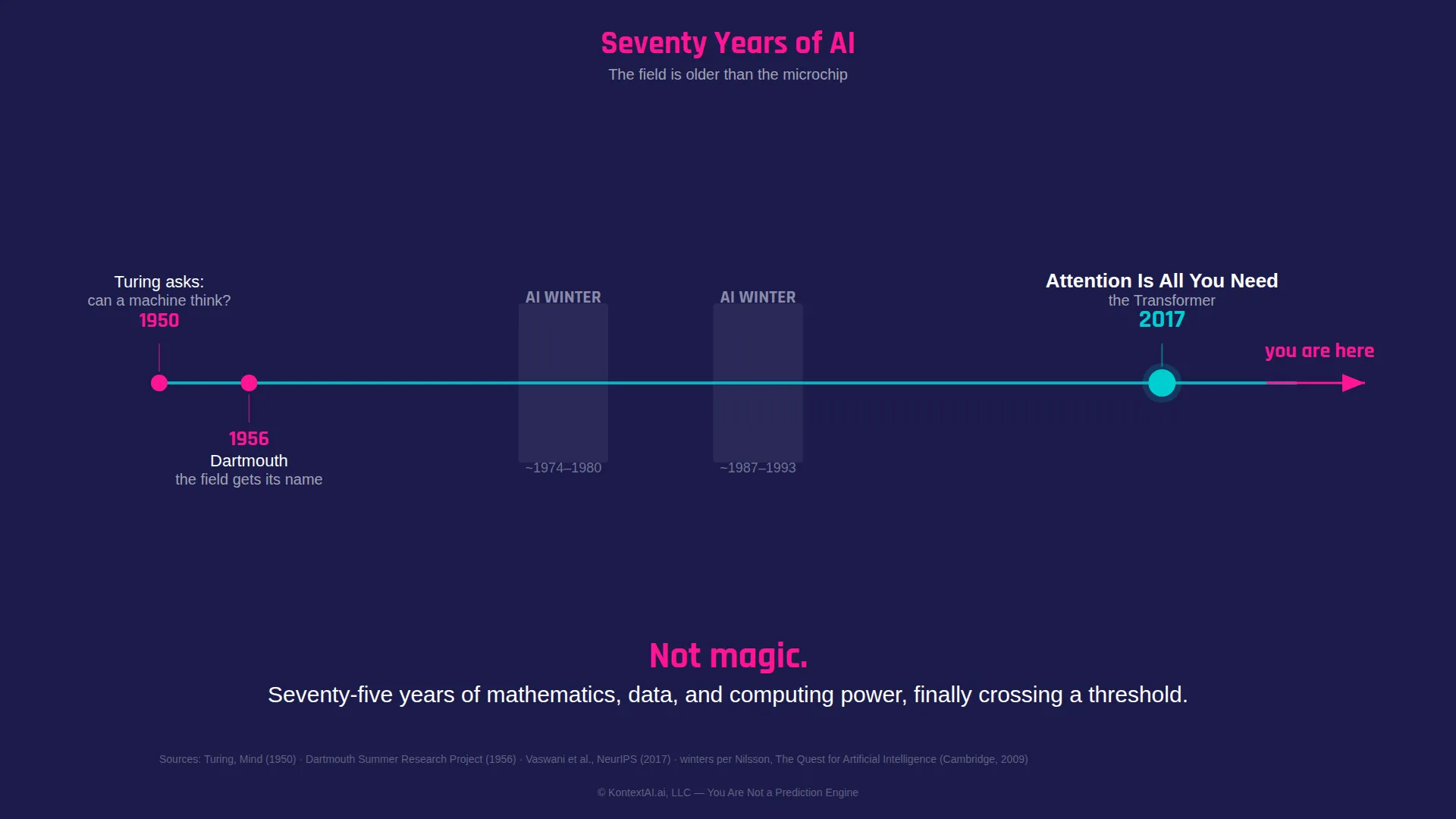
Picture a diesel bulldozer rolling up to someone from 1900, a roaring iron beast that does the work of a hundred men, that moves a hillside before lunch. They’d call it witchcraft. It wasn’t. It was thirty years of engines and steel and hydraulics, compounding. Today’s AI is exactly that: not magic, but seventy-five years of mathematics and data and computing power, finally crossing a threshold.
The mystique is the dangerous part. Believe it’s magic, and you’ll believe it can do anything, including replace you. Understand it’s a machine, a brilliant and history-made one, and you’ll see precisely what it’s for, and what it can never be.
And let’s say this plainly, because it matters: we are in awe of what these companies have built. The breakthrough is real, and it belongs to real people doing extraordinary work. NVIDIA forged the silicon that turned a research curiosity into a force that reshaped the world. Google gave us the Transformer itself (that 2017 paper was theirs) and decades of the research everyone else now builds on. OpenAI put astonishingly capable AI tools into the hands of hundreds of millions and changed what the world believes a machine can do. And Anthropic, whose Claude and Claude Code we build with every single day, does work of rare seriousness about safety and about the human, and we are better for it. We are not here to tear anyone down. We stand on their shoulders. Our quarrel was never with the brilliance of the engine — only with who it is pointed at.
Which brings us to the question almost no one stops to ask: what is this thing actually doing?
What an AI actually does
Let’s pull back the curtain, because the mystique is doing a lot of work.
A large language model, the thing behind ChatGPT, Claude, Gemini, and the chatbots most people mean when they say AI, is at its core a prediction engine. That’s not a metaphor. It is the literal mechanism. It reads the text so far and predicts the next token, a unit of about four characters. Then it does it again. And again. That is the whole mechanism.
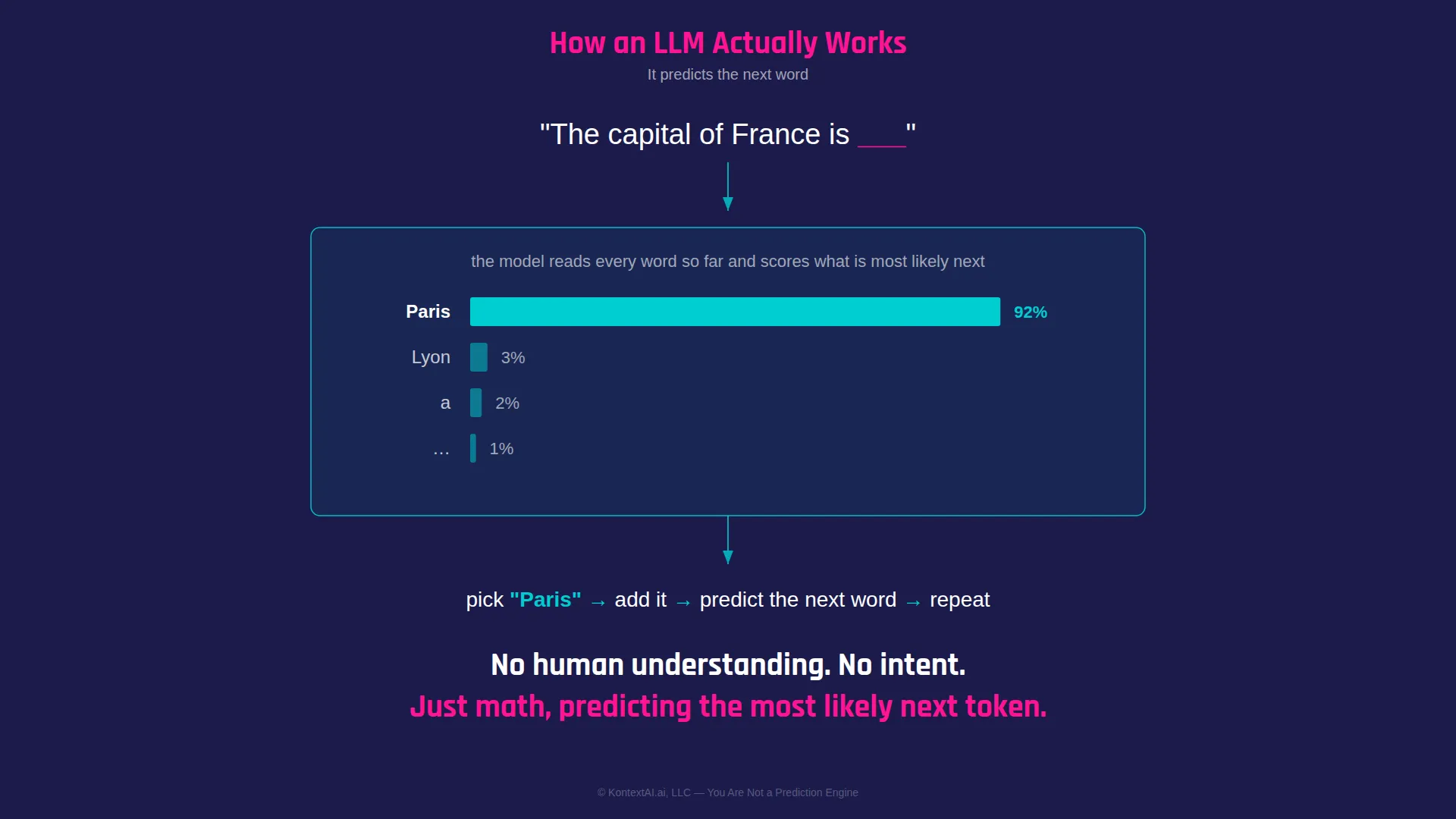
There is no human understanding in there. No intent, no inner life, no spark of will. There is a staggeringly large amount of math, trained on a staggeringly large amount of text, computing one thing very, very fast: given everything written so far, what comes next?
It feels like magic. Of course it does. Technology always feels like magic right up until you understand it. Electricity was magic. A human voice carried across an ocean on a wire was indistinguishable from sorcery to people who had never seen it. AI is the latest in a long line of marvels that look like minds and turn out, on inspection, to be machines. Wonderful machines. But machines.
And here is the most important fact about a prediction engine: it works from what already exists. It is interpolation from the past. Everything it produces is a recombination of patterns it has already seen, brilliant at the average, the expected, the most-likely. It can generalize in surprising ways, but it does not originate. Yes, a machine once stunned the world’s best Go player with a move no human would have played. It did it inside a game humans invented, by rules humans wrote, chasing a goal humans set. Brilliance inside the box is still the box. No machine has ever decided the box was wrong. The genuinely new idea, the one that was not already latent in everything it has read, is not the machine’s.
You have those ideas every day.
You cannot be quantized
People have been trying to reduce the human being to numbers for a very long time. Every era has its version: the skull-measurers, the IQ-sorters, the personality-typers, and now the model-builders who believe that with enough parameters they’ll finally capture you in a vector.
It has never worked. It never will.
Not because we lack the computers. Because the thing that makes you you is not a quantity. Your taste. Your judgment. The strange leap your mind makes from a sunset to a sentence to an idea worth building. The connection no one else would have drawn. These are not in the training data, because they have never happened before — they are happening, for the first time, in you.
History keeps proving it. In October 1903, the New York Times estimated that a working flying machine was one to ten million years of engineering away. Sixty-nine days later, two bicycle mechanics from Dayton, Ohio flew. The experts had scored the most likely next thing, exactly the way a prediction engine would. The Wright brothers built the unlikely one. That is the human move. It always has been. And it never comes only from the credentialed few: it comes from shop owners, from nobodies, from whoever refuses to accept that the most likely answer is the final one.
At KontextAI, we’ll say it plainly: we believe God created you. That He planned you — specifically you — before time began. We are not ashamed of this; it is simply who we are. We believe God values you. And we exist to amplify you.
A model predicts the next likely thing. You produce the unlikely thing, the one worth having. That gap is not a temporary engineering problem that a bigger model will close. It is the difference between remixing the past and creating the future. And it is permanent.
The bulldozer and the skyscraper
So will AI replace people? For some work, yes. Let’s be honest about it.
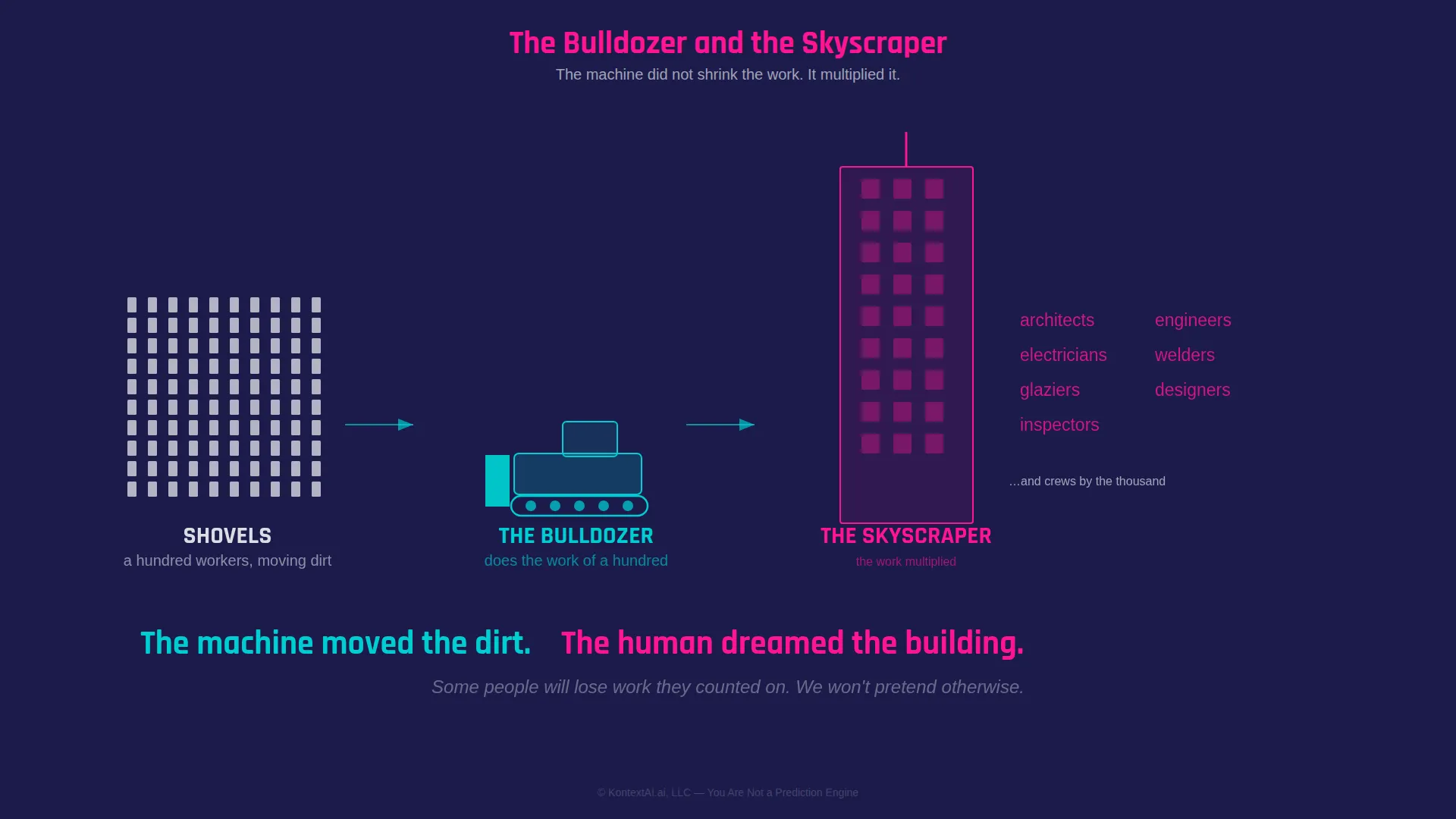
We met the bulldozer a moment ago, as the machine that once looked like magic. Here’s its second lesson. A bulldozer replaced a hundred men with shovels. The rote, the repetitive, the work that is essentially “move this dirt from here to there”: a machine will do that faster, and it should. AI is a bulldozer for cognition. The routine paragraph, the standard summary, the predictable reply: an algorithm will handle those, and you’ll be glad to hand them over.
But let’s not be glib about the cost. Some people will lose work they counted on: real jobs, real livelihoods, not abstractions. It is happening, it is painful, and we will not pretend otherwise. Anyone who promises you this transition will be painless is selling something.
And yet here is what we believe, and would stake everything on: there is a spark in every single person. Not only the gifted, the famous, or the ones who got a head start: everyone. The cashier, the driver, the teacher, the kid who hasn’t found their thing yet. Each of them carries something no machine will ever have. We don’t want that spark managed, or replaced, or optimized away. We want it amplified.
Now look at what actually happened with the bulldozer.
It did not end work. Over the last century, earth-moving machines did not shrink the work; they multiplied it, because they made the skyscraper possible. And the skyscraper needed architects, engineers, electricians, welders, glaziers, designers, inspectors, and crews by the thousand that a world of shovels could never have supported. The machine moved the dirt. The human dreamed the building. And the building created more human work than the shovel ever did.
Honestly? We don’t know how this ends. We could be wrong. It is possible AI displaces more than it amplifies, that this time the skyscraper never gets built. We won’t insult you by claiming a certainty no one actually has. But our faith is in the creative spark of human beings being irreplaceable — and if we had to bet everything we have on one side of that question, we would be all in on you. And on me. On the humans.
A bulldozer never envisioned a skyscraper. It never will. That is not what it is for.
This is the part the dystopians always miss. Technology, embraced and owned, doesn’t shrink human potential — it multiplies it. The question was never “will the machine replace me?” The question is “will I pick up the machine, or stand in front of it?”
When the bulldozer arrived, there were two workers holding shovels. One set his shovel down and walked away, beaten. The other set his shovel down, climbed into the bulldozer, and began to move earth, inspired by human dreams. We exist for that second worker — for everyone willing to put down the old tool and take hold of the new one.
But what about AGI?
There is one word the entire industry is chasing, and you’ve heard it: AGI, artificial general intelligence. A machine that can do everything a human mind can do, and then some. It is the holy grail of nearly every major lab: what they raise billions to build, what they put at the top of their mission statements, the future they are certain is coming. For a lot of very smart, very powerful people, AGI is not a product. It is the whole point. It’s what they live for.
And here is what almost no one names out loud: AGI is the modern Tower of Babel. The same ancient dream in new clothes: a structure raised high enough, its builders are sure, to finally reach the heavens. We won’t single anyone out; collectively, though, the field is pouring its genius into that one tower, convinced that if it just grows tall enough, it stops being a machine and becomes something more. It won’t. That is the whole lesson of the story.
So let’s take it seriously. Suppose they build it. Suppose one day there really is a machine as generally capable as a person.
Here is what doesn’t change.
A more powerful prediction engine is still a prediction engine. AGI would be the most extraordinary bulldozer ever built, but it would still be moving dirt at superhuman speed, not dreaming the building. It would still be remixing everything humans have already done, not having the idea no one has had yet. And the instant it exists, the person who wields it pulls ahead of it — because a human with AGI can ask the question AGI would never think to ask. Whoever holds the tool wins. A tool can outperform us at a task. It never decides what the task is for.
So no. We are not afraid of AGI, and we are not racing to build it. We don’t need to. If the labs get there, good: it simply becomes the next most powerful instrument we inject your context into. We will amplify AGI with the human — and we will bet on the human every single time.
Because no amount of “general” intelligence makes a machine a person. God created Adam. Not HAL. We’ll keep building for the one made in His image. And if the aliens ever come, they won’t ask for a tour of the AI data centers. They’ll come to study the humans.
Who KontextAI is
So here is where we stand, and what we are building.
Generally speaking, Big AI is in a race to build a better model. Bigger, faster, more “general,” all the way to AGI. That is their bet — that the model is what matters most.
We are not in that race, and we don’t need to be. We’re not trying to build AGI — we’re trying to amplify you. Our goal is to make every model yours.
An AI is only as good as the context it is given. Feed a model generic input, and it gives you the generic, average answer, the one it would give anybody. Feed it your knowledge — your files, your work, your voice, the things only you know — and the very same engine starts predicting your answer instead of the average one. The model didn’t change. The context did. That is the entire game, and it is the thing we do.
We call it the YOU prediction engine. You bring any model you like: ChatGPT, Claude, Gemini, an open-source model on your own machine, a future AGI we haven’t met yet. We inject your context into it. And it goes from predicting the world’s average to predicting you.
That makes us provider-agnostic on purpose. We are not here to beat the labs at their game; we are here to make their work serve you. Use whatever model you love. We amplify you with it. And here is the quiet truth in that: models come and go; they get better, cheaper, and replaced every few months. The model is ephemeral. Your context is forever. We build on the part that’s still yours when this year’s model is obsolete.
And not building the model ourselves doesn’t make us less of an AI company. It makes us the one company whose entire reason for existing is to point all of this astonishing technology back at the human being it is supposed to serve. KontextAI believes humans have and will continue to change the world. Not AI.
What this means for you
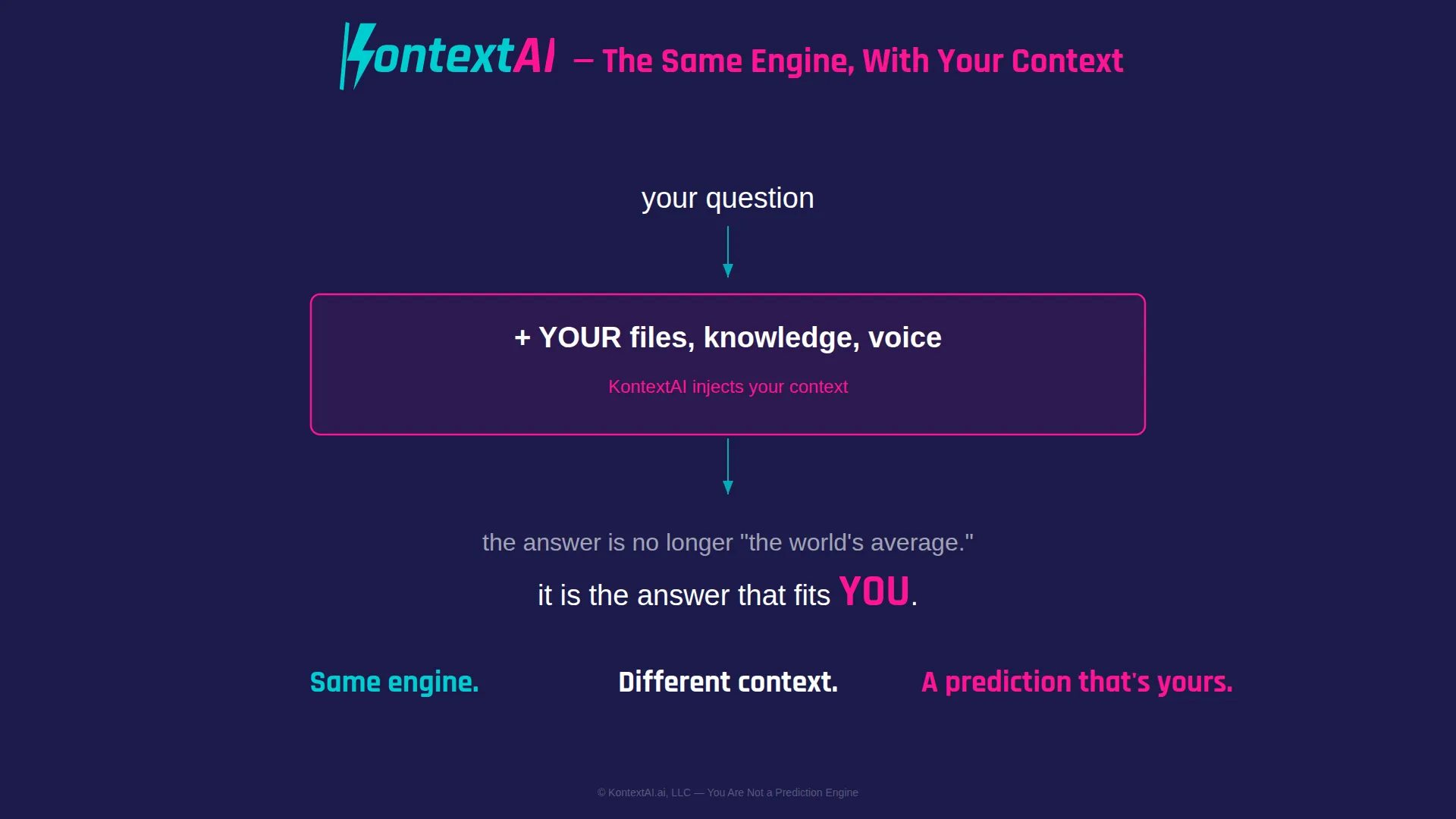
Here is what it looks like in practice. You take what you know: your documents, your notes, your expertise, the hard-won knowledge that makes you good at what you do. You turn it into an AI that actually knows your material. Not a generic chatbot. An agent that carries your context and answers from it, and shows you the exact source behind every answer. No black box; a glass box.
Your knowledge stays yours. We do not train models on it, because we do not build models at all. There is no KontextAI model for your work to disappear into. That is not a promise we are asking you to take on faith; it is what we are. We do not dissolve your knowledge into a model that serves everyone and credits no one. It lives in your space, it works for you, and you can take it with you or delete it whenever you want.
Own your context. Own your tokens. You, amplified — not assimilated.
That is the whole promise, and it is available to one person at a time, starting with you.
AI changed our lives. We want it to change yours.
For KontextAI, AI has transformed how we work, how we think, how we create, and it has been extraordinary. But we are not naive about it, either. We are clear-eyed about the risks, including the ones we are probably still underestimating. A tool this powerful will be misused, and it will test us in ways we cannot fully see yet. We do not look away from that. We just refuse to let it write the ending. KontextAI has been amplified by AI, and we built it for one reason: so you can have that same transformation, on your own terms.
Because used right, AI is not a replacement. It is an augmentation tool — an amplification tool. It takes what a person already is and makes them more, most of all when they own the context. That is the whole of what we enable: not a machine that does the work, but a tool that makes the human better at it than they have ever been. We want to make your spark brighter, not see it suppressed and drained into some dystopian energy grid that powers the world and leaves you dark.
And we’ll tell you exactly who we are, without apology: we are built by people who believe in God, Creator of heaven and earth in the Judeo-Christian tradition, and who believe He made you on purpose. The human mind, the human spark, that one-of-a-kind way of seeing the world is His design. And no machine ever built will be worth more than a single human soul or spirit. That is not a marketing line. It is the ground we stand on, and it is the reason we exist. We are not here to evangelize; you do not have to believe a word of it to be entirely welcome here. But it is why we will always build for the human, and never for the machine: creativity unleashed, not automated away, not assimilated into an averaged, digitized everyman.
So don’t fear the future they sold you. Rise up. Embrace the technology. Keep control. Own your context. Own your tokens. Own your own personal token factory. Don’t build someone else’s. We’re here to amplify you.
It was always going to be the humans who change the world. Not the AI.
Sources
- Alan Turing, “Computing Machinery and Intelligence,” Mind, 1950: the question of whether a machine can think.
- The Dartmouth Summer Research Project on Artificial Intelligence, 1956: where John McCarthy coined the term “artificial intelligence.”
- Ashish Vaswani et al., “Attention Is All You Need,” NeurIPS, 2017: the Transformer architecture and the attention mechanism behind today’s models.
- Nils J. Nilsson, The Quest for Artificial Intelligence: A History of Ideas and Achievements, Cambridge University Press, 2009: field timeline and the AI winters of ~1974–1980 and ~1987–1993.
- “Flying Machines Which Do Not Fly,” The New York Times, October 9, 1903: the editorial estimating a flying machine was one to ten million years away — published sixty-nine days before the Wright brothers flew at Kitty Hawk on December 17, 1903.